Advice categories
Advice categories
Explore by searching or quick selecting below:
Advice category: Understanding non-fault claims
Side impact collisions – who’s at fault?

Reviewed by Ian Budsworth -
Written by Tyler Lally
Last updated on October 31, 2025
The driver who fails to give way is usually at fault. This is because drivers must ensure the path is clear before entering a road or changing lanes.
However, exceptions may apply if the driver with priority was speeding excessively, running a red light, driving without lights at night, or giving misleading signals.
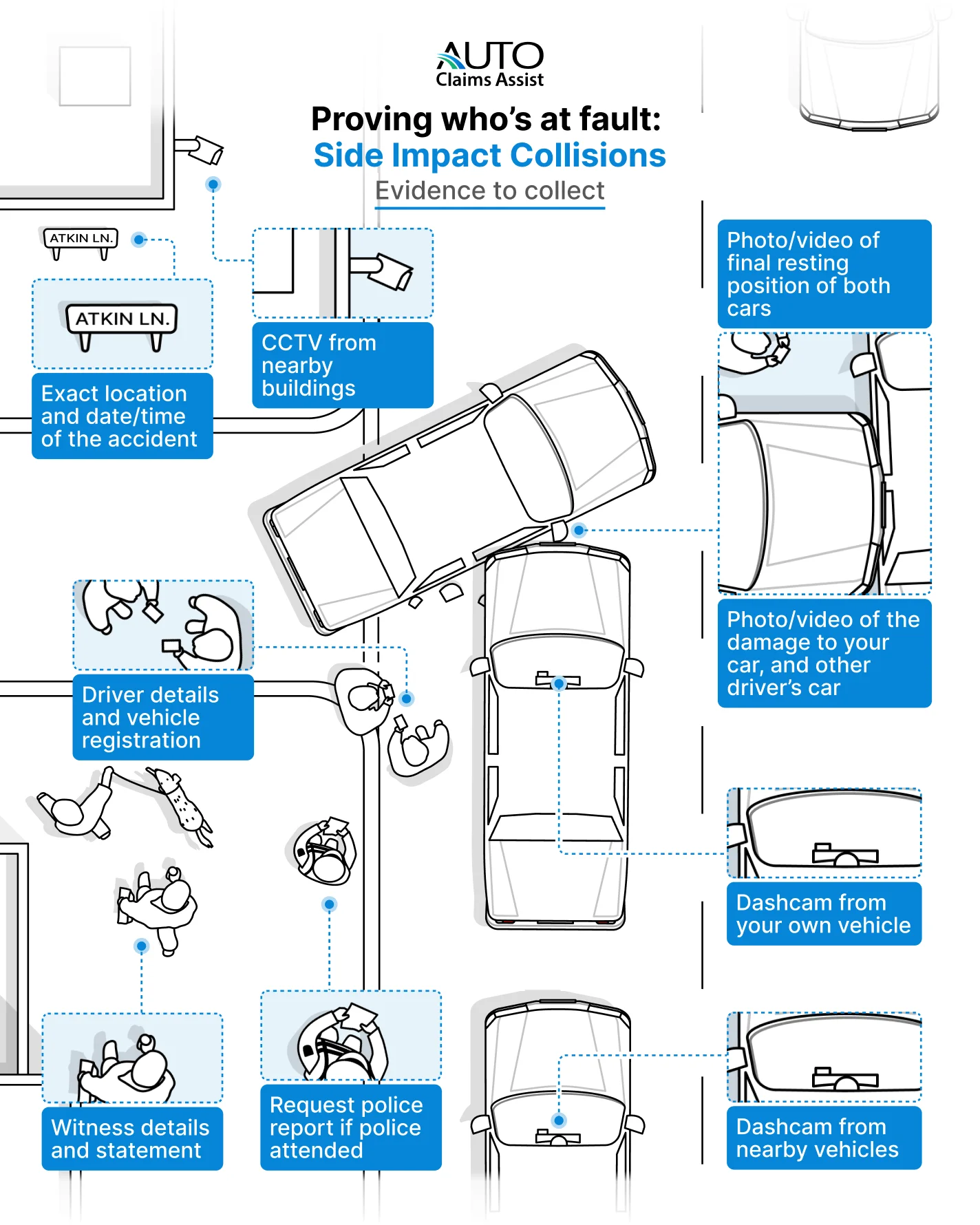
Proving responsibility relies on clear evidence, including dashcam or CCTV footage, photographs of vehicle positions and damage, or witness statements.
Determining fault in a side-impact collision
The Highway Code states that drivers have a duty of care to give way to traffic that has priority.
While this general rule is simple, not every side-impact collision is the same.
Straightforward non-fault scenarios
- At a T-junction: If a vehicle pulls out from a side road and enters the path of another vehicle, the driver pulling out will be held at fault.
- At a roundabout: If a driver fails to give priority to vehicles from the right and causes a collision, the driver failing to give priority will be held at fault.
- Making a right turn: If a vehicle turns right across the path of another vehicle, the turning driver is at fault.
Exceptions to the ‘general rule’
- Excessive speed: If the priority driver was travelling significantly above the speed limit or too fast for the conditions, the other driver may argue the speed made it impossible to judge a safe gap.
- No headlights at night: If the priority driver was driving without their headlights on at night or in poor visibility, the other driver may argue they could not see them.
- Misleading signals: If the priority driver was indicating to turn (or flashing their headlights) in a way that wrongly suggested the other driver had time or priority to pull out, the other driver may argue they were signalled to proceed.
- Running a red light: If a driver was found to have run a red light, the other driver may argue that running the red light meant they no longer had priority.
How to prove you weren’t at fault
When you’re involved in a side-impact collision, it’s important to gather as much evidence as you can at the scene.
The evidence you collect will help support your claim if the other driver later denies responsibility.
You should collect:
- Dash cam footage/cctv: This is the most definitive evidence you can have.
- Witness statements: An independent witness's account is valuable evidence.
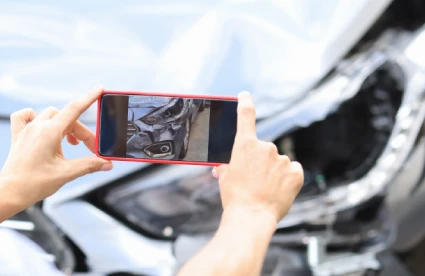
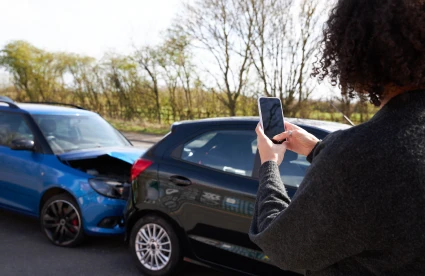
- Vehicle damage: Take photos showing the points of impact on both vehicles and the wider scene.
- Final position of vehicles: Note the final resting position of the cars.
- Police report: An official report can provide an unbiased record of the accident.


What causes side-impact collisions?
- Failure to give way: A driver fails to stop or give way to traffic, such as at a roundabout, a junction, or when pulling out of a driveway.
- Distracted driving: A driver is not paying attention to the road e.g. using a mobile phone, eating, or any other distractions.
- Running a red light: Where a driver enters a junction after the light has changed.
- Misjudging an oncoming vehicle: A driver turning across traffic misjudges the speed or distance of an oncoming car, leading to a collision.
- Driving under the influence (DUI): A driver's judgment and reaction time are impaired by alcohol or drugs, leading to careless and dangerous decision making.
After a side-impact collision: your first steps
Dealing with an accident can be stressful, but these simple steps will protect you and your claim.
- Stop your vehicle safely and turn on your hazard lights.
- Check for injuries and call for emergency services if needed.
- Exchange details with the other driver.
- Take photos of the scene, including the vehicles' damage and the relevant road markings, signs, or traffic lights.
How Auto Claims Assist can help if you were not at fault after a side-impact collision

After a side-impact collision, dealing with a claim can be overwhelming and stressful.
If you weren’t at fault, we can manage your claim from start to finish, getting you back on the road as quickly as possible.
We provide:
- A dedicated claims handler to manage your claim from start to finish.
- 24/7 Nationwide recovery
- A like-for-like vehicle while yours is off the road.
- Vehicle repair at a BSI-Kitemark accredited garage using only manufacturer approved parts and paints.
- A lifetime guarantee on your repairs (for as long as you own that vehicle)
- A fair pre-accident valuation if your vehicle is written off.
All at no cost to you.
Any costs associated with your claim are recovered directly from the at-fault driver’s insurer, on your behalf.
Frequently Asked Questions
What happens when the driver who caused the accident admits fault, but then denies it later?
It’s common for drivers to change their story once they speak to their insurer. That’s why your best defence is the evidence you gather at the scene: photos, dash cam footage, and independent witness statements. This objective evidence can prove what happened, regardless of the other driver’s revised claim.
What is the legal difference between ‘duty of care’ and ‘right of way’?
Right of way dictates who has priority to move (e.g., traffic on a main road). Duty of care is the general legal responsibility every driver has to drive safely and avoid harming others (e.g., maintaining proper observation, appropriate speed). Both principles determine fault.
What if I have been injured in the collision?
If you have been injured, or begin to feel pain after the collision. We can refer you on to our panel of specialist solicitors, who will focus on getting you the care and support you need for a full recovery.
Will I have to pay for your service?
Our service is at no cost to you. We recover all costs, including vehicle repairs and a like-for-like replacement vehicle, directly from the at-fault driver’s insurer. Your no-claims bonus remains unaffected, and you have no excess to pay.
Current Version
Oct 31, 2025
Oct 31, 2025
Related articles
Request a callback