Advice categories
Advice categories
Explore by searching or quick selecting below:
Advice category: Understanding non-fault claims
Rear-ended - who’s at fault?

Reviewed by Ian Budsworth -
Written by Tyler Lally
Last updated on October 31, 2025
The driver who hits the rear of another vehicle is usually at fault. This is because drivers are required to maintain a safe stopping distance at all times.
However, exceptions may apply if the lead driver stops abruptly without a valid reason or has broken brake lights.
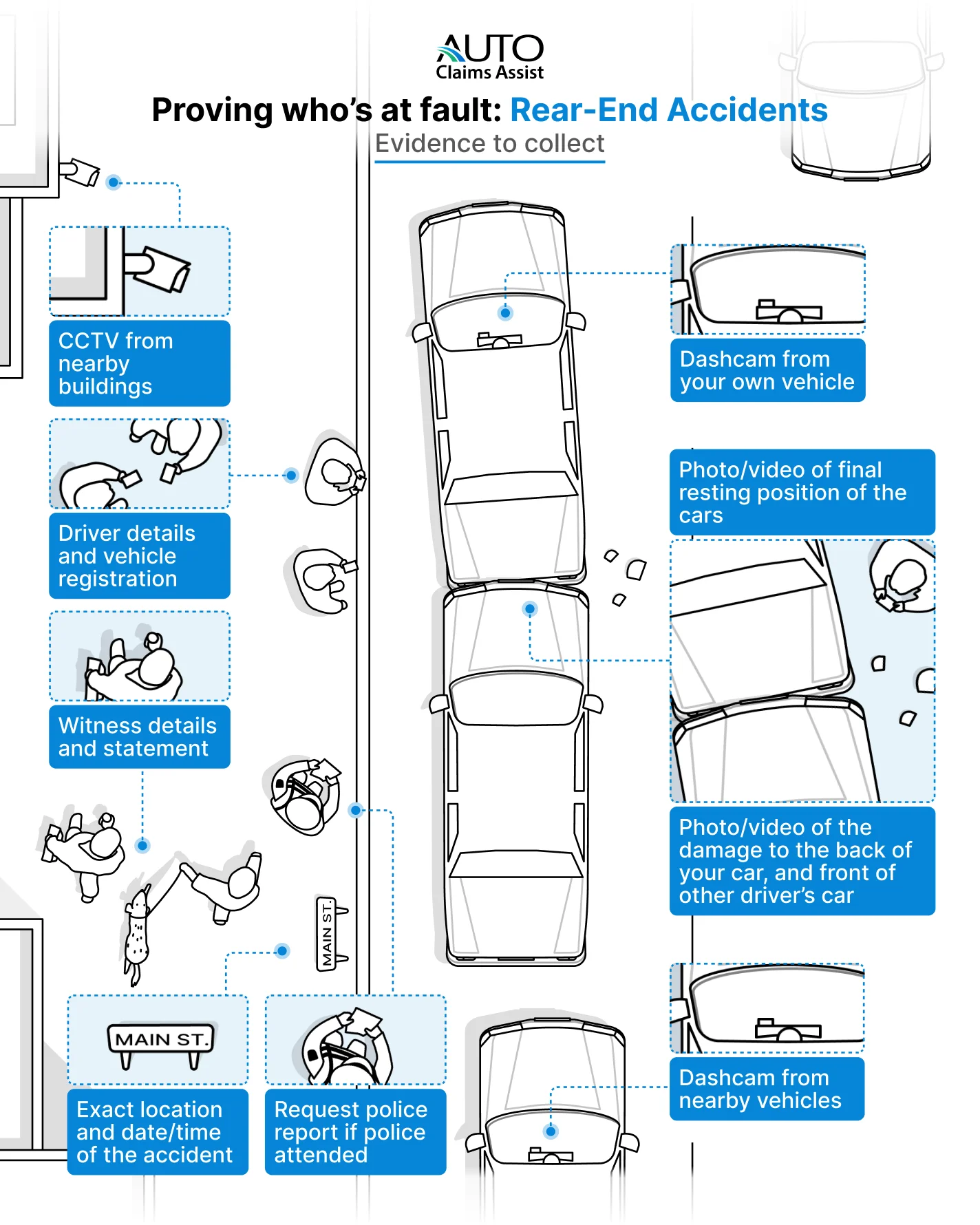
Proving responsibility relies on clear evidence, such as dashcam or CCTV footage, photographs of the vehicles, or witness statements.
Determining fault in a rear-end collision
The Highway Code states that drivers have a duty of care to maintain a safe braking distance from the vehicle in front.
While this general rule is simple, not every rear-end accident is the same.
Straightforward non-fault scenarios
- Stopped at traffic lights or in a queue: If a vehicle is stationary and is hit from behind by another vehicle, the driver behind is always at fault.
- Slowing down for traffic: If a vehicle is slowing down for traffic ahead and is rear-ended by another vehicle, the driver behind is at fault.
Exceptions to the ‘general rule’
- Sudden braking without a valid reason: If the lead vehicle stops abruptly without cause, the driver behind may argue the hazard was unavoidable.
- Broken brake lights: If the lead vehicle’s brake lights are not working, their failure to follow vehicle lighting regulations may be a contributing factor.
How to prove you weren’t at fault
When you’re involved in a rear-end accident, it’s important to gather as much evidence as you can at the scene.
The evidence you collect will help support your claim if the other driver later denies responsibility.
You should collect:
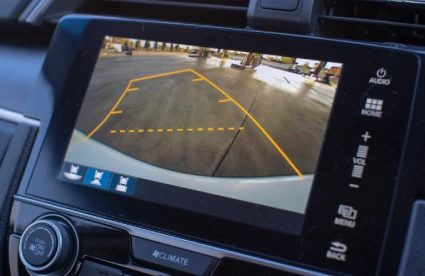
- Dash cam footage/cctv: This is the most definitive evidence you can have.
- Witness statements: An independent witness's account is invaluable evidence.
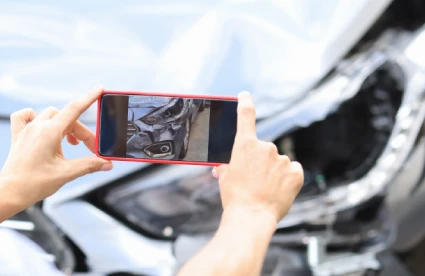
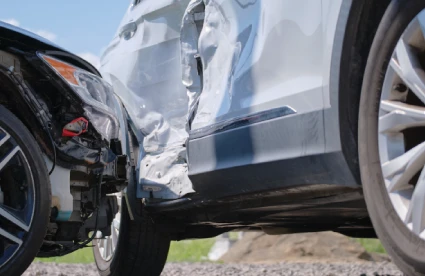
- Vehicle damage: Take photos showing the front of the at-fault vehicle and the rear of your car.
- Final position of vehicles: Take photos of the final resting position of the cars at the scene.
- Police report: An official report can provide an unbiased record of the accident.


How common are rear-end collisions?
Based on 1,614 recent calls, rear-end collisions account for 21.56% of all accidents reported to Auto Claims Assist, making them the third most common accident type in the data.
For comparison, the two most frequently reported accident types were: 1. parked vehicle hits (32.34%) and 2. junction collisions (25.28%).
What causes rear-end collisions?
- Tailgating: Failing to maintain a safe braking distance from the vehicle in front is the primary cause of a rear-end collision.
- Distracted driving: A driver who is not paying attention to the road may fail to notice the vehicle in front of them slowing down or stopping, leading to a collision.
- Sudden braking: A driver who brakes abruptly without warning can cause a rear-end collision if the following driver is unable to stop in time.
- Poor road conditions: Factors like bad weather, black ice, or slick roads can reduce a vehicle’s stopping distance, causing a driver to collide with the car in front of them.
- Lack of vehicle maintenance: Faulty brakes or worn tyres can prevent a driver from stopping in time, making them unable to avoid hitting the vehicle ahead.
After a rear-end collision: your first steps
Dealing with an accident can be stressful, but these simple steps will protect you and your claim.
- Stop your vehicle safely and turn on your hazard lights.
- Check for injuries and call for emergency services if needed.
- Exchange details with the other driver.
- Take photos of the damage, especially to the rear of your vehicle and the front of theirs.
How Auto Claims Assist can help if you were not at fault
After a rear-end collision, dealing with a claim can be overwhelming and stressful.
If you weren’t at fault, we can manage your claim from start to finish, getting you back on the road as quickly as possible.
We provide:
- A dedicated claims handler to manage your claim from start to finish.
- 24/7 Nationwide recovery
- A like-for-like vehicle while yours is off the road.
- Vehicle repair at a BSI-Kitemark accredited garage using only manufacturer approved parts and paints.
- A lifetime guarantee on your repairs (for as long as you own that vehicle)
- A fair pre-accident valuation if your vehicle is written off.
All at no cost to you.
Any costs associated with your claim are recovered directly from the at-fault driver’s insurer, on your behalf.
FAQs for Rear-End Collisions
What if the other driver admitted fault at the scene but is now denying it?
It is not uncommon for a driver to change their story. This is why collecting evidence like photos, dash-cam footage, and witness statements at the scene is so important. This evidence can prove what happened regardless of the other driver’s claim.
What if I have been injured in the collision?
If you have been injured, or begin to feel pain after the collision. We can refer you on to our panel of specialist solicitors, who will focus on getting you the care and support you need for a full recovery.
Will I have to pay for your service?
Our service is at no cost to you. We recover all costs, including vehicle repairs and a like-for-like replacement vehicle, directly from the at-fault driver’s insurer. Using us won’t affect your no claims bonus, and you have no excess to pay.
Current Version
Oct 31, 2025
Oct 31, 2025
Related articles
Request a callback